
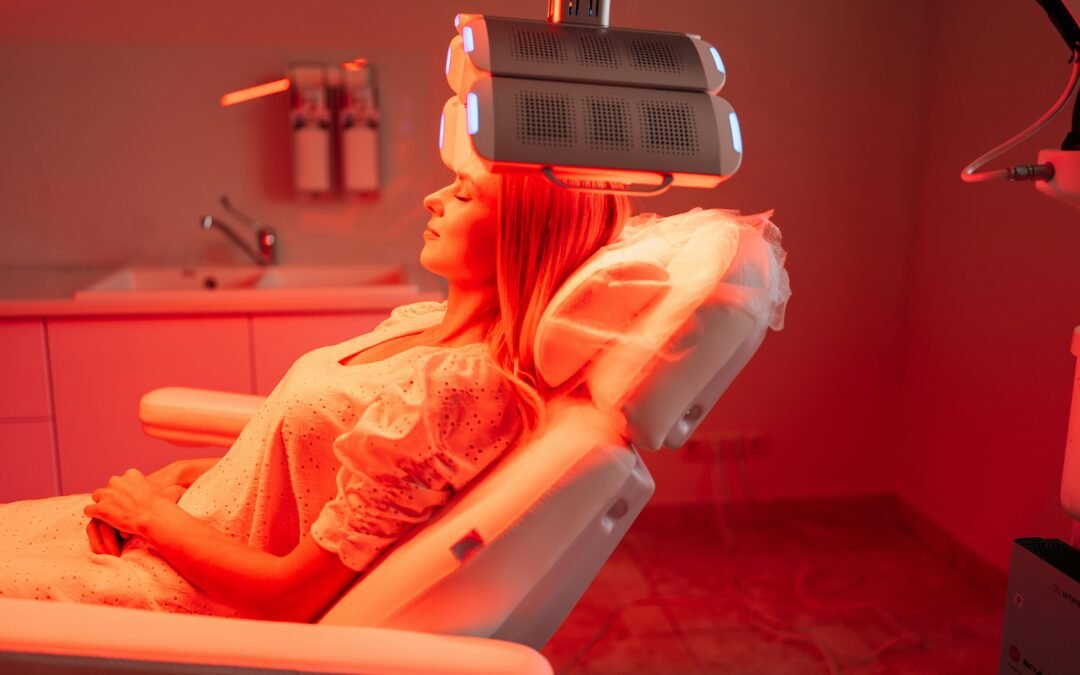
Red light panels used to live in dermatology offices and pro sports training rooms. Now they sit on nightstands, ride in gym bags, and take over your social feed. So what actually works, and what is just a warm red glow with a big price tag?
Here is a simple way to picture it. Your cells run on tiny power plants called mitochondria. Red and near-infrared light give those power plants a small nudge, kind of like a phone charger topping off a low battery.
The Science Behind It
Certain wavelengths of light get absorbed by an enzyme in your mitochondria called cytochrome c oxidase. That absorption helps cells make more ATP, which is the fuel your body runs on (Hamblin, 2018). More fuel can mean faster repair and less inflammation in the area getting the red light.
Two ranges of red light do the heavy lifting: red light around 630 to 660 nanometers, which stays near the surface and suits skin, and near-infrared around 810 to 850 nanometers, which reaches deeper into muscle and scalp.
And research shows it’s not just hype, studies do show measured benefits.
Skin is where red light therapy has the strongest track record. A controlled trial found measurable increases in collagen density along with reduced wrinkles and roughness after consistent use over several weeks (Wunsch & Matuschka, 2014). Lab and clinical work has also shown that pulsed 660 nm light changes how skin cells regulate collagen production, an effect that shows up on actual biopsy (not just in how skin looks) (Barolet et al., 2009).
For muscle recovery, timing changes the outcome a fair amount. An endurance-training trial in 77 healthy volunteers found that applying photobiomodulation before and after treadmill sessions for 12 weeks significantly improved time to exhaustion and oxygen uptake versus placebo, with body fat also improving at later time points. The study’s authors concluded that the before-and-after protocol improved endurance about three times faster than exercise alone (Miranda et al., 2018).
Interestingly, a related trial from the same research group found that for strength training, applying light only before the workout produced the best results, and adding a second session afterward didn’t help (Vanin et al., 2016). So the “right” protocol depends on what you’re training for: endurance work seems to benefit from bookending the session, strength work doesn’t. A device that ships with one generic setting, or worse, no session timer at all, can’t account for that difference. If you’re using red light for recovery, it’s worth doing a little research to ensure you’re factoring in the right timing for your specific workout.
Hair is the trickiest category. A 24-week randomized trial on androgenetic alopecia found real improvement with low-level light therapy, but results took months, not days, and were modest compared to what marketing photos suggest (Fan et al., 2018). If you’re expecting a thick head of hair within weeks, skip it. If you’re willing to commit to a slow, steady input alongside everything else you may already be doing for your scalp, it’s worth a look.
What to Look For
- Wavelength. Look for devices that clearly list their wavelengths, such as red light in the 630 to 660 nm range and near-infrared light in the 810 to 850 nm range. If a product uses vague language like “therapeutic light” without specific numbers, that is a warning sign.
- Irradiance. This is the actual power hitting your skin, measured in mW/cm². It matters because two devices can have the same wavelength but deliver very different doses. Cheap panels often list total wattage, which tells you almost nothing about what your skin receives.
- Distance and session time. Follow the manufacturer’s recommended distance and session length, but be skeptical of products that promise dramatic results in only a few minutes.
- Regulatory status. FDA clearance can be useful as a basic quality check, but it does not guarantee that a device will work for your specific goal.
What to Skip
Skip devices that do not disclose wavelength or irradiance, rely on vague wellness language, or make sweeping claims that sound too good to be true. Be cautious with products that give no guidance on distance, timing, or treatment frequency, since those details matter for dose. Also be wary of marketing that treats all red light devices as interchangeable, because the research does not support that assumption.
Good, Better, Best Routines
Skin: Good is a device with clearly listed wavelengths and a consistent schedule you can actually maintain. Better is a larger device or panel used at the manufacturer’s recommended distance and session length. Best pairs red light with a consistent skincare routine, and realistic expectations, since light therapy is usually an add-on rather than a standalone fix.
Recovery: Good is using a device consistently after workouts, with attention to the recommended distance and dose. Better is choosing a device whose setup is closer to the protocol used in research for your specific goal, whether that means closer placement or a higher documented irradiance. Best is matching the timing to the type of training you do, since exercise studies suggest that protocol details matter and results are not identical across endurance and strength training.
Scalp: Good is a laser cap used every other day (or according to the product’s frequency suggestion). Better extends that to 16 to 24 weeks minimum before judging results. Best treats it as one piece of a scalp health routine that includes reducing inflammation and stress load, dialing in nutrition, and considering other supportive scalp therapies such as PRP.
Nutritional Therapy focuses on supporting the body’s foundations first and doesn’t treat any single tool as the whole answer. Red light therapy can be a helpful tool for supporting cellular energy and tissue repair, but it’s not a replacement for sleep, nutrition, movement, hydration or stress management. Used with realistic expectations, it can be a useful addition to a broader plan.
We have tried several wellness tools over the years, and the Lumebox has become a favorite red and near-infrared light device because it’s portable, convenient, and delivers professional level power in a size that’s easy to use every day. We only share products that we have personally used and truly love. If you choose to purchase through the link below, we receive a small affiliate commission (at no extra cost to you). It helps support the educational content we create, and we are grateful for your support.
If you have any questions, book a Discovery call with us and we can talk more about it.
References
Hamblin, M. R. (2018). Mechanisms and mitochondrial redox signaling in photobiomodulation. Photochemistry and Photobiology, 94(2), 199–212.
Wunsch, A., & Matuschka, K. (2014). A controlled trial to determine the efficacy of red and near-infrared light treatment in patient satisfaction, reduction of fine lines, wrinkles, skin roughness, and intradermal collagen density increase. Photomedicine and Laser Surgery, 32(2), 93–100.
Barolet, D., Roberge, C. J., Auger, F. A., Boucher, A., & Germain, L. (2009). Regulation of skin collagen metabolism in vitro using a pulsed 660 nm LED light source: Clinical correlation with a single-blinded study. Journal of Investigative Dermatology, 129(12), 2751-2759.
Miranda, E. F., Tomazoni, S. S., de Paiva, P. R. V., Pinto, H. D., Smith, D., Santos, L. A., de Tarso Camillo de Carvalho, P., & Leal-Junior, E. C. P. (2018). When is the best moment to apply photobiomodulation therapy (PBMT) when associated to a treadmill endurance-training program? A randomized, triple-blinded, placebo-controlled clinical trial. Lasers in Medical Science, 33(4), 719-727.
Vanin, A. A., Miranda, E. F., Machado, C. S., de Paiva, P. R., Albuquerque-Pontes, G. M., Casalechi, H. L., de Tarso Camillo de Carvalho, P., & Leal-Junior, E. C. (2016). What is the best moment to apply phototherapy when associated to a strength training program? A randomized, double-blinded, placebo-controlled trial: phototherapy in association to strength training. Lasers in Medical Science, 31(8), 1555-1564.
Fan, S. M. Y., Cheng, Y. P., Lee, M. Y., Lin, S. J., & Chiu, H. Y. (2018). Efficacy and safety of a low-level light therapy for androgenetic alopecia: A 24-week, randomized, double-blind, self-comparison, sham device-controlled trial. Dermatologic Surgery, 44(11), 1411-1420.
Recent Comments